

Solopreneur Business Thinking Canvas
A practical tool for building a solo business that fits your life, values, and goals
Starting a solo business doesn’t require a 40-page business plan. But it does benefit from clear thinking.
The Solopreneur Business Thinking Canvas is a flexible, plain-language tool designed specifically for people 50+ who want to build a business that is purposeful, manageable, and sustainable— without employees.
It helps you:
-
- Clarify what you want to do—and why
- Understand how your skills, experience, and interests translate into value
- Think through income, workload, pricing, and support needs realistically
- Design a business that works without staff, often using contractors and tech instead
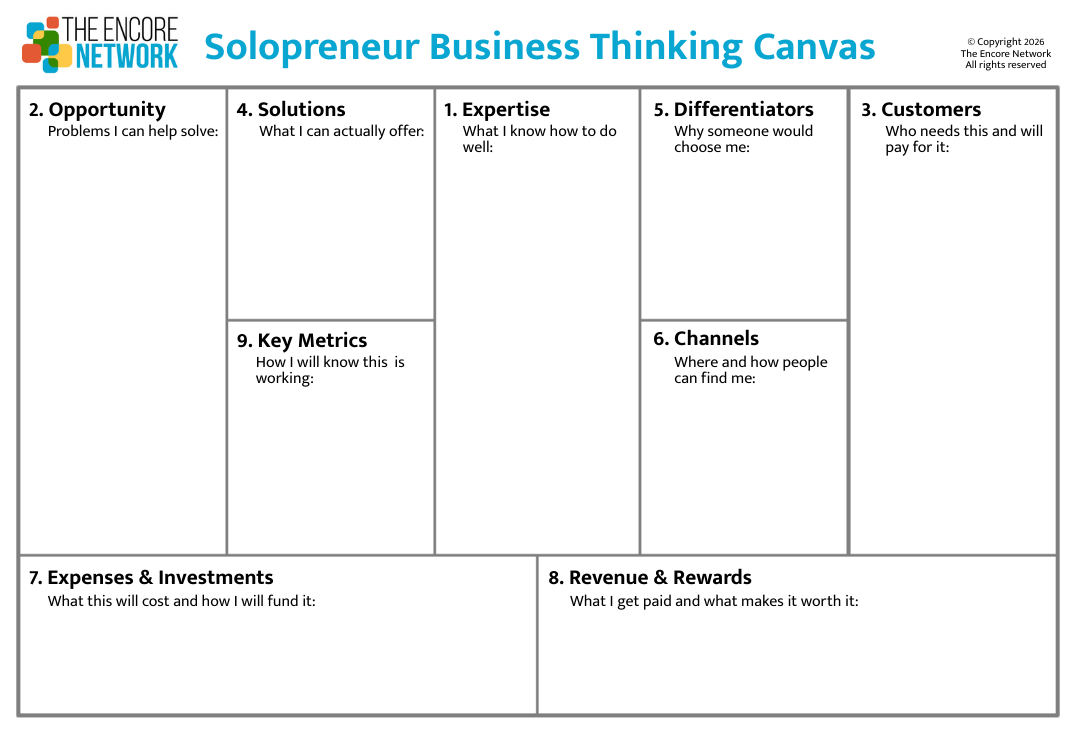
How the Solopreneur Business Thinking Canvas Links to the Hub
Use the questions in the middle column in this chart to think about each part
of the Canvas. The column on the right shows how it links to the Hub,
where you can find related and helpful information.
Canvas Category
Thinking Prompts
Hub Sections
1. What I Know How to Do Well
(Expertise)
Thinking Prompts
What skills, knowledge, or experience do people already come to me for?
What have I done for years that now feels second nature?
What problems have I solved repeatedly across roles or careers?
Hub Sections
A – Mindset, Risk & Confidence
C – Learning, Preparation & Readiness
Canvas Category
2. Problems I Can Help Solve
(Opportunity)
Thinking Prompts
What frustrations, inefficiencies, or unmet needs do I understand deeply?
Whose problems do I care enough about to keep working on?
Where does my experience clearly reduce risk, confusion, or wasted effort?
Hub Sections
A – Mindset & Confidence
C – Readiness
F – Brand & Messaging
Canvas Category
3. Who Needs This and Will Pay for It
(Customers)
Thinking Prompts
Who benefits most from what I offer?
Who has the authority—and budget—to pay for help?
Where are these people already looking for solutions?
Hub Sections
F – Brand, Messaging & Awareness
G – Marketing, Sales & Upselling
Canvas Category
4. What I Can Actually Offer
(Solutions)
Thinking Prompts
What services or outcomes am I realistically willing to deliver?
What can I offer that fits a solo business model?
What can I do well without hiring employees?
Hub Sections
B – Self-Management
D – Leveraging Resources & Professionals
E – Tech & AI Tools
Canvas Category
5. Why Someone Would Choose Me
(Differentiators)
Thinking Prompts
What makes my approach different or more trustworthy?
How does my experience reduce mistakes, risk, or rework?
Why would someone choose me over a cheaper or younger alternative?
Hub Sections
A – Confidence
F – Brand & Messaging
Canvas Category
6. Where and How People Can Find Me
(Channels)
Thinking Prompts
How do people currently find and learn about my work?
Which channels feel natural, not draining, to maintain?
Where does my audience already spend time?
Hub Sections
F – Brand & Awareness
G – Marketing & Sales
E – Tech & AI Tools
Canvas Category
7. What This Will Cost and How Will I Fund It
(Expenses & Investments)
Thinking Prompts
What do I actually need to spend money on to get started?
What can I keep simple or delay?
What tools or services will save me time or stress?
Hub Sections
D – Leveraging Resources & Professionals
E – Tech & AI Tools
B – Self-Management
Canvas Category
8. How I Will Know This Is Working
(Key Metrics)
Thinking Prompts
What signs tell me I’m making progress?
What matters more right now: income, leads, learning, or visibility?
How often will I pause to review and adjust?
Hub Sections
B – Self-Management
G – Marketing & Sales
E – Tech & Tracking Tools